 English
 русский
 عربى
عربىIndustry News
Home / News / Industry News / Seamless Stainless Steel Pipe Dimensions: NPS, Schedule & Tolerances Explained

Steel Sourcing · Machining · Procurement
Every seamless pipe order comes down to three numbers and one set of tolerances. This guide explains how nominal pipe size, schedule walls, and the governing standards translate into the steel that actually arrives at your loading dock.
The short version first: for seamless stainless steel pipe, the dimensions that define the product are outside diameter (OD), wall thickness, and length — and none of them reliably matches the name printed on the order. "Two-inch pipe" does not measure two inches across; it measures 2.375 inches, or 60.3 mm, and every experienced buyer in the trade knows it.
That single fact trips up newcomers more than anything else in pipe procurement. A machining shop that orders 2-inch pipe expecting a 50.8 mm outside diameter receives a perfectly standard bundle of 60.3 mm pipe, and both parties are technically correct. The label is Nominal Pipe Size (NPS), a naming convention inherited from cast-iron piping, not a measurement you can put calipers on.
So the useful question for a buyer is never "what size is this pipe?" but "what are the OD, the wall thickness, and the tolerances on both?" Schedules, standards, and weight formulas all exist to answer that one question precisely.
Seamless stainless steel pipe dimensions are standardized by ASME B36.19M, the dimension standard for stainless pipe. It fixes the outside diameter for every nominal size, then defines wall thickness series called schedules — 5S, 10S, 40S, and 80S in everyday stainless work, where the S marks the stainless series. The logic is deliberately simple: the schedule changes the wall, never the OD, which is why every schedule of a given size shares the same outside geometry.
Because the OD holds still while the schedule climbs, NPS 2 pipe in Schedule 10S (1.65 mm wall) and the same size in Schedule 80S (5.54 mm wall) share identical outside geometry. One detail worth carrying to the checkout: through NPS 10, Schedule 40S walls are identical to ordinary Schedule 40 carbon steel walls, and 80S matches 80 through NPS 8. Above those sizes the stainless series drifts to slightly different values, so copying a carbon steel chart for a large stainless line is a quiet way to order the wrong wall.
| Nominal size (NPS) | Actual OD, in / mm | Wall, SCH 10S, mm | Wall, SCH 40S, mm |
|---|---|---|---|
| 1/2 | 0.840 / 21.3 | 1.24 | 2.77 |
| 1 | 1.315 / 33.4 | 1.65 | 3.38 |
| 2 | 2.375 / 60.3 | 1.65 | 3.91 |
| 4 | 4.500 / 114.3 | 2.11 | 6.02 |
| 6 | 6.625 / 168.3 | 2.77 | 7.11 |
| 8 | 8.625 / 219.1 | 3.76 | 8.18 |
Seamless does not automatically mean pipe dimensions. The trade runs on two sizing systems, and picking the wrong one is an expensive error for anyone who machines parts from the raw material.
We looked at the material side of this family separately in our guide to the characteristics of stainless steel pipes; here the point is narrower — buyers who turn, bore, or grind their stock usually switch from pipe logic to tube logic, even inside the seamless category.
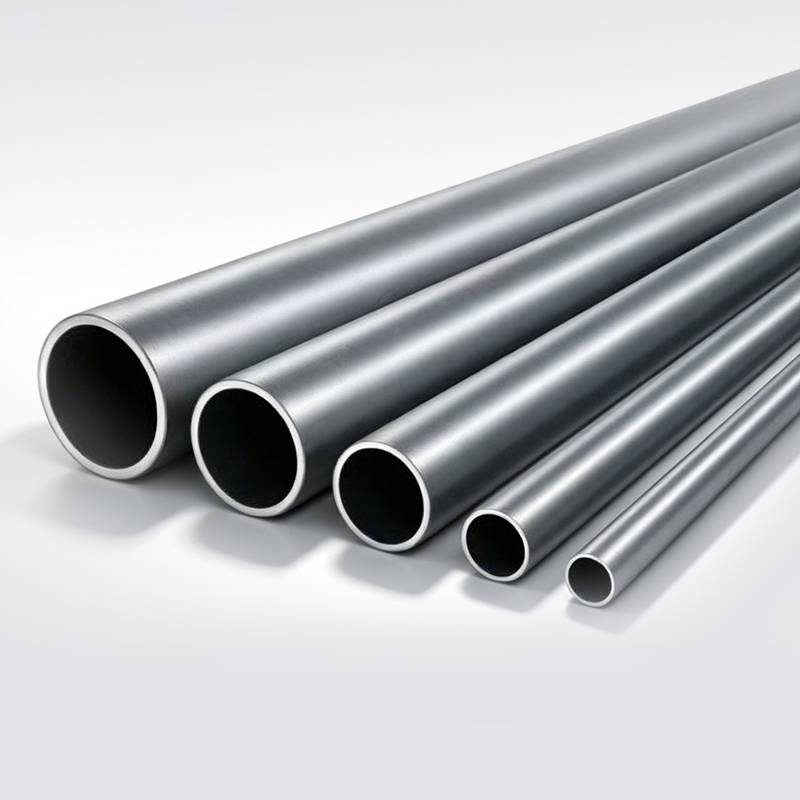 45# Carbon Steel Seamless Pipe for Machining and Pressure UseSeamless 45# carbon steel pipe with customizable 12–120 mm OD and 1.5–15 mm wall, offering strength and pressure resistance. Readers weighing pipe wall tolerances for machined parts may prefer controlled seamless stock.View Product →
A nominal wall is a target, not a guarantee. Under the general requirements standard that governs seamless stainless pipe, ASTM A999, wall thickness is commonly held to ±12.5% of the nominal wall for seamless product. On a real example: NPS 4 pipe with a 6.02 mm Schedule 40S wall may legally arrive anywhere from roughly 5.27 to 6.77 mm. For a pressure line, that is fine. For a machined bushing that needs 5.6 mm of wall after turning, it is a scrap bin.
On the shop floor, the distance between a schedule and a scrap bin is usually measured in tenths of a millimeter.
Outside diameter follows the same philosophy: small sizes carry a fixed absolute deviation — about ±0.4 mm through NPS 1-1/2 — while larger sizes are held to a small percentage of the OD. Length brings its own terms: seamless pipe ships in random lengths, commonly around 6 meters, unless cut lengths are agreed with a stated tolerance.
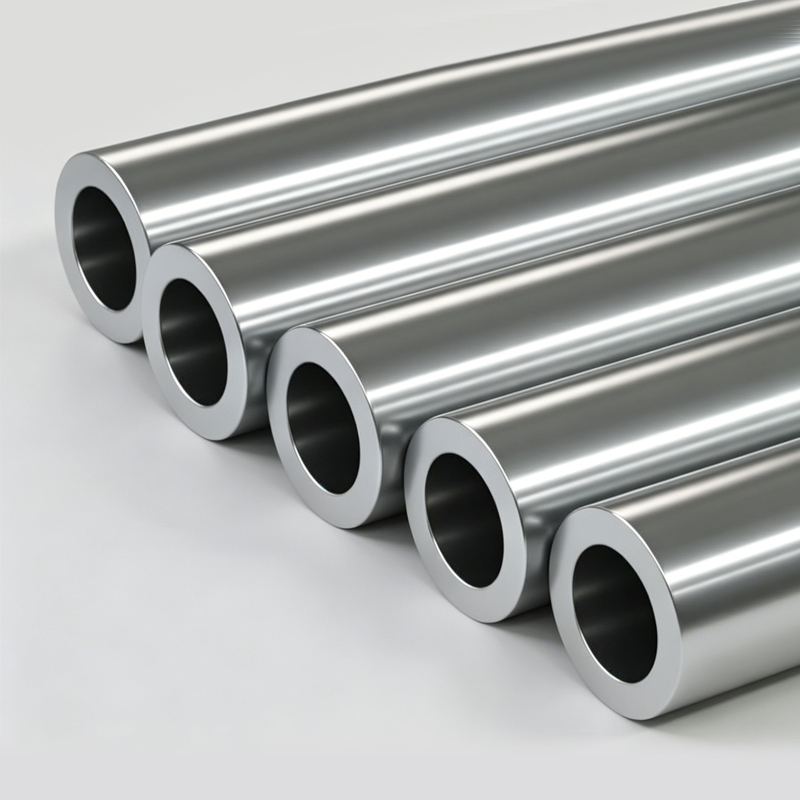 High Strength 40Cr Alloy Seamless Steel Pipe for MachineryQuenched and tempered 40Cr seamless pipe with tight cold-drawn or hot-rolled tolerances and good machinability. When OD, wall, and length tolerances drive an RFQ, this alloy pipe suits demanding machinery applications.View Product →
Conclusion first: a good stainless pipe RFQ is four lines long. Anything left out becomes a phone call, an assumption, or a claim later.
Everything above belongs to stainless line pipe, but the dimension logic is not exclusive to it. Whether the order is 316L pipe for a process line or a cold-rolled carbon steel blank for a power-tool spindle, the discipline is identical: fix the OD, set the wall, state the tolerance, and make the certificate prove it.
That is the daily work at Zhejiang Qibin Steel Pipe Technology Co., Ltd., a seamless pipe producer running 21 cold-rolling lines for mechanical-grade tubing in grades such as 20, 45, 20Cr, 20CrMo, 40Cr, and 60Si2Mn — material that feeds power-tool, automotive, motorcycle, and general machinery component shops. Non-round profiles belong to the same conversation: a shaped blank is itself a dimension decision, because it removes metal you would otherwise machine away.
If there is one habit worth taking away, it is this: quote dimensions as OD × wall × tolerance × standard, never as a nickname. It is the difference between steel that conforms and steel that fits.


Seamless Stainless Steel Pipe Schedule: What the Callout Really Fixes A schedul...
Read MoreSeamless Piping Specification Seamless Stainless Steel Pipe Standards: A Buyer'...
Read MoreSteel Pipe Specification · Tolerance Engineering Seamless Stainless Steel Pipe...
Read MoreSeamless Stainless Steel Pipe Meaning: A One-Piece Tube Without a Weld What th...
Read More

 No. 8, Fengshan Road, Industrial Park, Mohuan Township, Longyou County, Quzhou City, Zhejiang Province, China.
 +86-18857033688
 postmaster@zj-qibin.com

