 English
 русский
 عربى
عربىIndustry News
Home / News / Industry News / Seamless Stainless Steel Pipe Manufacturing Process: Step-by-Step Guide

The plant engineer weighing quotes for a stainless steel instrument line usually sees the same gap: the seamless tube is noticeably more expensive than the welded alternative. That gap is not a surcharge; it is the cost of a fundamentally different way of making the tube. The seamless stainless steel pipe manufacturing process begins with a solid round billet and shapes that single piece into a hollow tube with no weld anywhere along its length. This choice fixes the entire sequence that follows — heating, piercing, elongating, cold finishing, heat treatment, and testing — and it determines the properties you will measure when the pipe reaches your incoming inspection bench.
In a welded pipe, a strip or plate is formed into a cylinder and the edges are joined by a longitudinal seam; spiral welded pipe works on the same principle. The product is reliable, but the seam is a different metallurgical zone. Its grain structure, chemistry and corrosion behavior never fully match the base metal, and the heat-affected zone next to the weld is where problems tend to start.
A seamless pipe has no such zone. Because a solid billet is pierced and elongated rather than bent and closed, the body is continuous from one end to the other. For stainless steel this matters more than for most materials: removing the weld removes the preferred initiation site for pitting and stress corrosion cracking in chloride-bearing environments. If the application cannot tolerate a weld seam, the pipe has to be made by the seamless route.
The raw material is a solid round billet of the specified grade: 304/304L or 316/316L for austenitic stainless, 321 for elevated-temperature service, and the matching carbon or alloy grade when the drawing calls for a non-stainless steel. Before the billet enters the furnace, it is inspected for surface cracks, internal soundness, and identity. This is not a formality: a chromium segregation zone or a surface lap can grow into a rejectable defect during piercing.
Heating takes place in a rotary hearth furnace. Stainless billets are brought to roughly 1200-1300°C, and because chromium and nickel lower thermal conductivity, the billet must soak until the center matches the surface temperature. An uneven temperature profile produces an eccentric wall at piercing, so the heating curve is part of the manufacturing specification. The same discipline applies to carbon and alloy grades at lower temperatures; our 20 carbon steel seamless pipe starts from a verified 20-grade billet handled with the same furnace control.
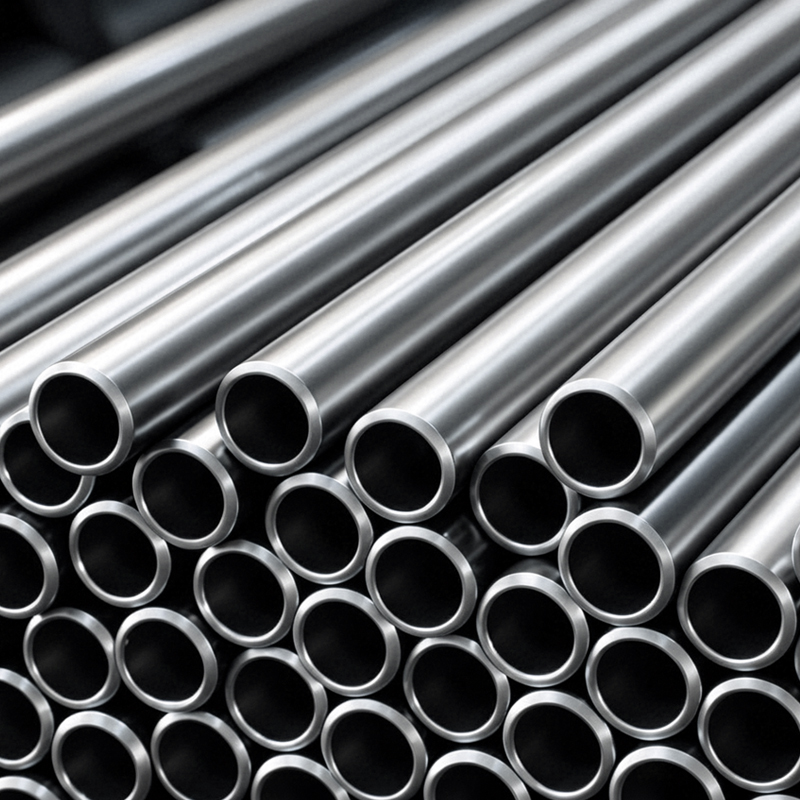 Wholesale 20# Carbon steel seamless pipe Suppliers, Factory - Zhejiang Qibin SteZhejiang Qibin Steel Pipe Technology Co., Ltd is China wholesale 20# Carbon steel seamless pipe suppliers and factory,Outer Diameter: 12m...View Product →
Piercing is the step that gives seamless pipe its identity. In the Mannesmann process, the heated billet is fed between two barrel-shaped rolls that rotate in the same direction on inclined axes. The cross-rolling action creates spiraling compressive stresses that open a cavity in the center of the billet, and a piercer plug mounted on a long bar forms that cavity into a smooth internal bore. What leaves this mill is a thick, short, hollow shell.
The margins are narrow: pierce too cold and internal cracks develop; misalign the tools and the wall comes out eccentric. Stainless grades are less forgiving than carbon steel, so some mills use hot extrusion instead: the billet is upset, pierced in a press, and pushed through a die on a mandrel. Both routes deliver the same starting point for the next stage — a hollow with no seam and a continuous grain flow that follows the shape of the part.
The hollow shell is shorter and thicker than the ordered pipe. It is elongated on a mandrel mill or a plug mill. In a mandrel mill, the shell is pushed over a long polished bar while successive rolling stands reduce the wall and stretch the length. A plug mill uses a short plug held on a bar at each pass instead.
The number of passes, the starting billet size, and the roll design together set the thinnest wall and the smallest diameter a mill can produce economically. This is where production capacity becomes visible: a full production line can control the wall in more steps, while a short line has to compromise on the starting hollow or accept a wider tolerance.
After elongation, the pipe passes through a sizing mill whose stands refine the outside diameter to the ordered dimension. The long lengths then cross a cooling bed, where they cool in a straight, controlled manner to keep residual stress and curvature low. A rotary straightener removes any remaining bend, and shallow surface defects are ground out at this point.
For structural and undemanding service, the hot-rolled product is now complete and can be cut, tested and shipped. But when a pipe will be machined into a precision component, the hot-rolled surface, dimensional tolerance and wall consistency are usually not good enough. The product then moves to cold finishing.
Cold finishing is what turns an ordinary seamless pipe into machining stock. Two process families dominate.
The hot-rolled pipe is pointed, pickled and lubricated, then pulled through a die while a plug or mandrel supports the bore. Drawing reduces the outside diameter, thins the wall, improves the surface finish, and raises strength through work hardening. It is the most economical route for many carbon, alloy and stainless sizes.
In cold rolling, usually on a pilger-type mill, the pipe is worked down in incremental passes between shaped rolls. Each pass produces a substantial reduction with a smooth surface and a very uniform wall. This is the route behind most precision cold-rolled seamless tube, and it is the core of our own production: we operate 21 cold rolling lines for exactly this stage. A product such as high-strength 40Cr alloy seamless steel pipe for machinery is made this way, because a machined component requires a wall consistent enough for every blank to finish in the same number of machining passes.
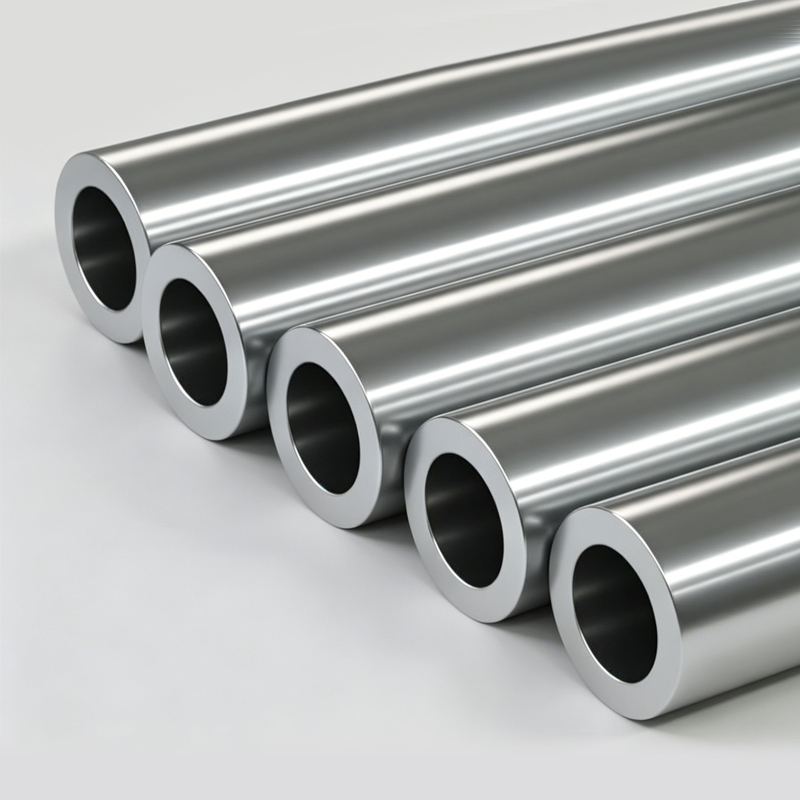 Wholesale High Strength 40Cr Alloy Seamless Steel Pipe for Machinery Suppliers, Zhejiang Qibin Steel Pipe Technology Co., Ltd is China wholesale High Strength 40Cr Alloy Seamless Steel Pipe for Machinery suppliers and...View Product →
Stainless adds one caution: austenitic grades work harden quickly, so cold passes must be interrupted by intermediate annealing and pickling. The same applies, in milder form, to alloy steels.
Every cold-finished pipe, and most hot-rolled pipe, must be put into its final metallurgical condition before release.
For stainless steel, the standard step is solution annealing: the pipe is heated to roughly 1010-1065°C and cooled rapidly enough to keep chromium carbides in solution, restoring the corrosion resistance that cold work can disturb. Pickling in an acid mixture then removes oxide scale and leaves a clean, chromium-enriched surface; bright annealing in a protective atmosphere is used when a smooth bright finish is required.
For carbon and alloy steels, the heat treatment follows the intended duty. Normalizing refines the grain; parts that must survive repeated loading are quenched and tempered. Spring steel is the clearest example, because its function is created by the heat treatment rather than by the rolling. The 60Si2Mn spring steel seamless pipe we supply is ordered in the quenched and tempered condition, and the elastic range is verified on the test bench instead of assumed from the grade name.
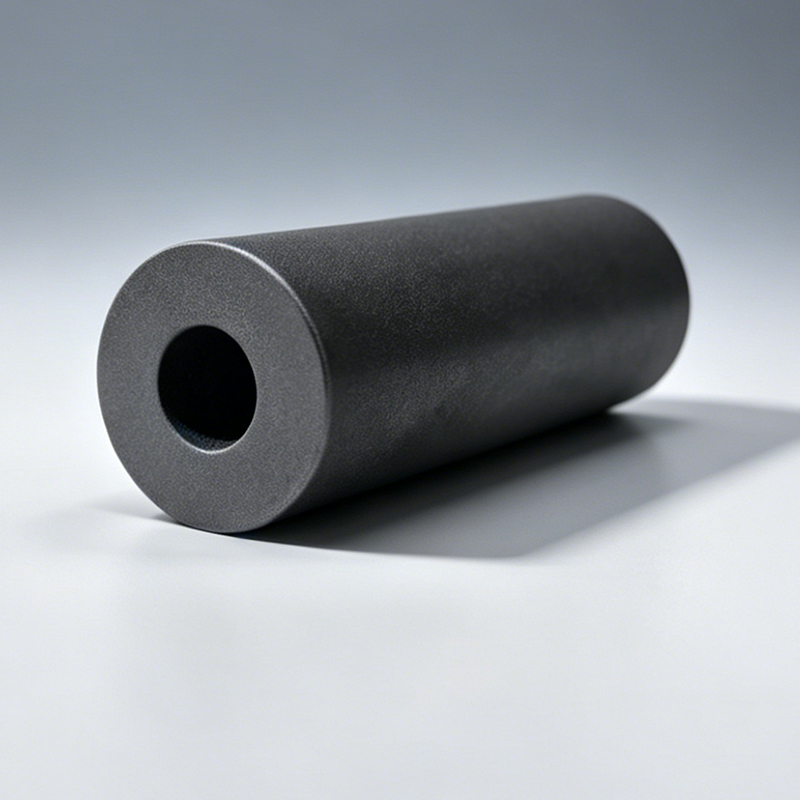 Wholesale 60Si2Mn Spring steel seamless pipe Suppliers, Factory - Zhejiang QibinZhejiang Qibin Steel Pipe Technology Co., Ltd is China wholesale 60Si2Mn Spring steel seamless pipe suppliers and factory,Outer diameter:...View Product →
The process is complete only when the pipe can prove what it claims. Mill inspection usually covers:
For stainless steel, purchasers often add positive material identification and, for demanding service, a resistance test for intergranular corrosion per ASTM A262. A serious mill ships each batch with its mill certificate: grade, heat number, dimensions, test results, and the standard to which the pipe was manufactured. Ask for it, and accept nothing less.
The most useful single question to ask when buying seamless pipe is which route the pipe actually took, because it predicts the values you will measure at incoming inspection.
| Parameter | Hot-Rolled Seamless Pipe | Cold-Finished Seamless Pipe |
|---|---|---|
| Outside diameter tolerance | Wider, typically a percentage of the diameter | Tight, typically hundredths of a millimetre |
| Surface condition | Oxide scale and rougher surface | Smooth, close to a finished part surface |
| Wall uniformity | Varies more along the length | Consistent along the length and around the circumference |
| Mechanical properties | As-rolled or normalized | Controlled by cold work and final heat treatment |
| Relative cost | Lower | Higher |
| Typical applications | Structural, general engineering | Machined parts, shafts, cylinders, automotive and machinery components |
Beyond the route, a few questions separate a mill with controlled process from a reseller:
A supplier who cannot answer these directly is probably trading the material rather than processing it. A mill that answers with batch numbers, furnace records and test reports is showing you its process control. If you are comparing material families, our guide to carbon steel seamless pipe selection explains how carbon grades differ from stainless and where each one fits.
The seamless stainless steel pipe manufacturing process is a long chain — billet inspection, controlled heating, piercing, elongation, sizing, cold finishing, heat treatment and testing. Every link exists because a weld-free body can only be built, not assembled, from a solid piece. Once you understand the chain, the price difference between seamless and welded pipe stops being a mystery and becomes a specification decision you can make with confidence.



Seamless Stainless Steel Pipe Meaning: A One-Piece Tube Without a Weld What th...
Read MoreTrade Classification · Seamless Steel Pipe The Seamless Stainless Steel Pipe HS...
Read MoreSteel Pipe Specification · Tolerance Engineering Seamless Stainless Steel Pipe...
Read MoreWhy "Easy to Maintain" Deserves a Place in Your Pipe Specification No plant man...
Read More

 No. 8, Fengshan Road, Industrial Park, Mohuan Township, Longyou County, Quzhou City, Zhejiang Province, China.
 +86-18857033688
 postmaster@zj-qibin.com

